Rose Parade History
Each New Year’s Day, the world watches the legendary Rose Parade glide down Colorado Boulevard in Pasadena.
When Was the First Rose Parade?
The first Rose Parade took place on January 1, 1890, when Pasadena’s Valley Hunt Club invited friends from the East Coast to see how flowers bloomed in the middle of winter. They decorated horse-drawn carriages with roses and held foot races, polo matches, and a tug-of-war. The idea caught on, and the Tournament of Roses was born.
How Old Is the Rose Bowl Parade?
Now more than 137 years old, the Rose Bowl Parade has evolved from a small neighborhood procession into an internationally televised event seen by millions. Each parade honors the original goal of coming together as a community and celebrating the beauty of Southern California.
Rose Parade History
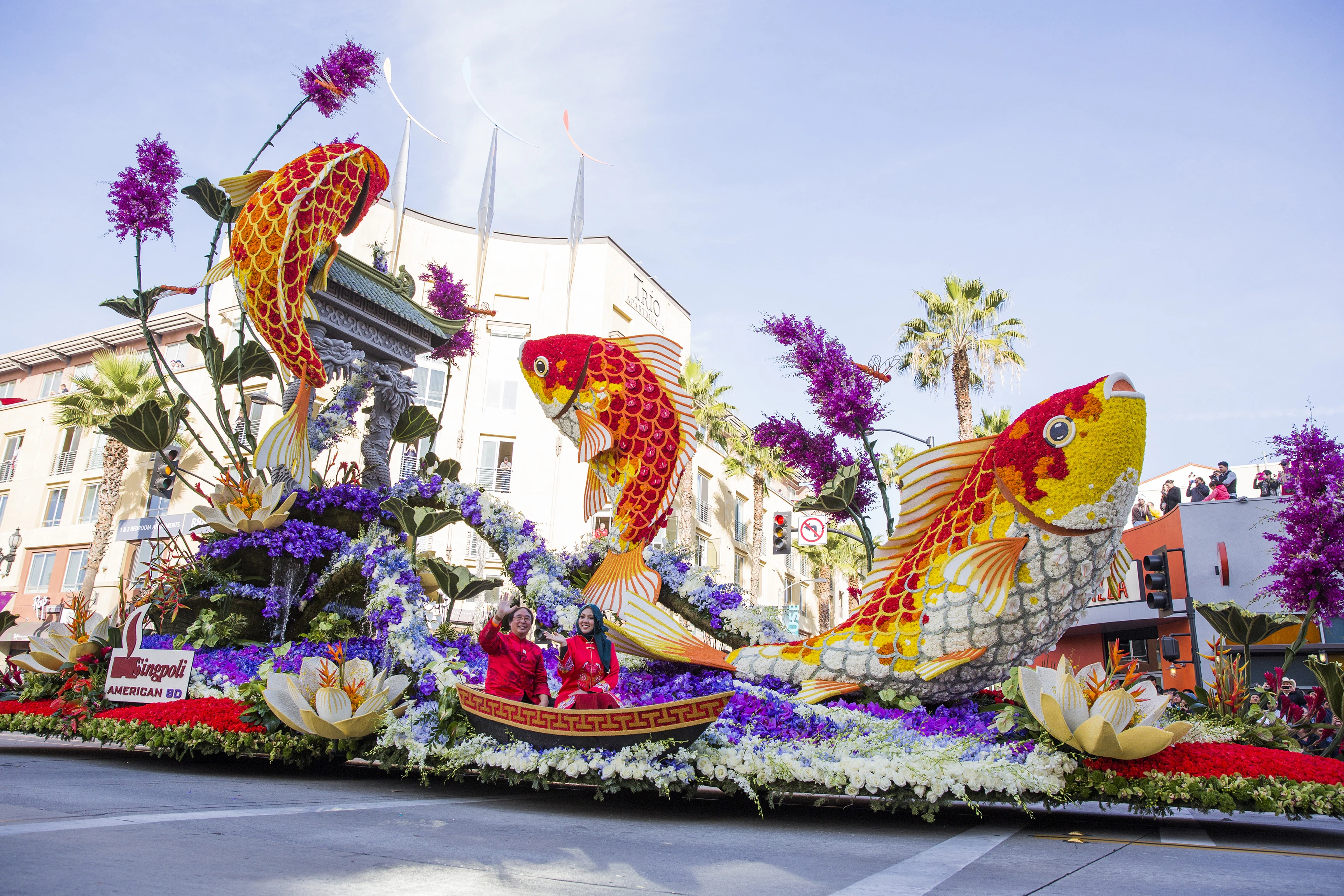
What began as a few carriages now features spectacular, flower-covered floats, marching bands, and equestrian groups from around the world. The Rose Parade has grown and evolved over the years, most notably with these additions:
Key Moments in Rose Parade History:
1890: The first Rose Parade is held by the Valley Hunt Club.
1895: The Tournament of Roses Association is formed as the event outgrows the Valley Hunt Club.
1902: The first Rose Bowl Game is played to attract more visitors. It featured the University of Michigan and Stanford University. Football was replaced by other events, such as chariot races, until it was reinstated in 1916.
1905: Hallie Woods was selected as the first Rose Queen, marking the beginning of the Royal Court tradition. The Royal Court consists of community members who serve as ambassadors for the Tournament of Roses Association and attend various events and functions.
1920: While motorized vehicles were introduced in the parade as early as 1901, they were initially placed at the rear of the route to avoid scaring the horses. By 1920, all floats were motorized. Horses remain an essential part of the parade in other ways.
1954: The parade is broadcast nationally for the first time.
Rose Parade Fast Facts
- Participants in the Tournament of Roses Association, often called the “White Suiters” because of their signature white uniforms and red ties, donate tens of thousands of hours each year to plan and execute the parade.
- Every float in the parade must be entirely covered with natural materials (flowers, seeds, bark, leaves, etc.). No part may show non-natural material on the float’s outer surface.
- The parade is always held on January 1, unless it falls on a Sunday, in which case it is held on January 2. This “Never on Sunday” rule has been in place since 1893 to prevent horses tied outside churches from being frightened and to avoid disrupting worship services.
- The route covers approximately 5½ miles in Pasadena, beginning at Green Street and Orange Grove, then onto Colorado Boulevard. Towards the end, it turns north onto Sierra Madre Boulevard and concludes at Villa Street.
- Each year, a new theme is chosen, and a grand marshal leads the procession. This helps keep the parade’s message fresh while preserving the tradition and pageantry. Parade themes officially started in 1927 with “Songs in Flowers.” The theme for 2026 is “The Magic in Teamwork.”
What started as a simple way to show off California’s winter blooms has become an event that attracts over 700,000 visitors to Pasadena and over 45.5 million viewers in the United States alone. Each January, eyes are on Pasadena and the Tournament of Roses, traditions that keep blooming every year.

Dec 29 to Dec 30
Robinson Stadium at Pasadena City College 1570 E. Colorado Blvd. Pasadena, CA 91106 (626) 795-4171 Website